How I got published
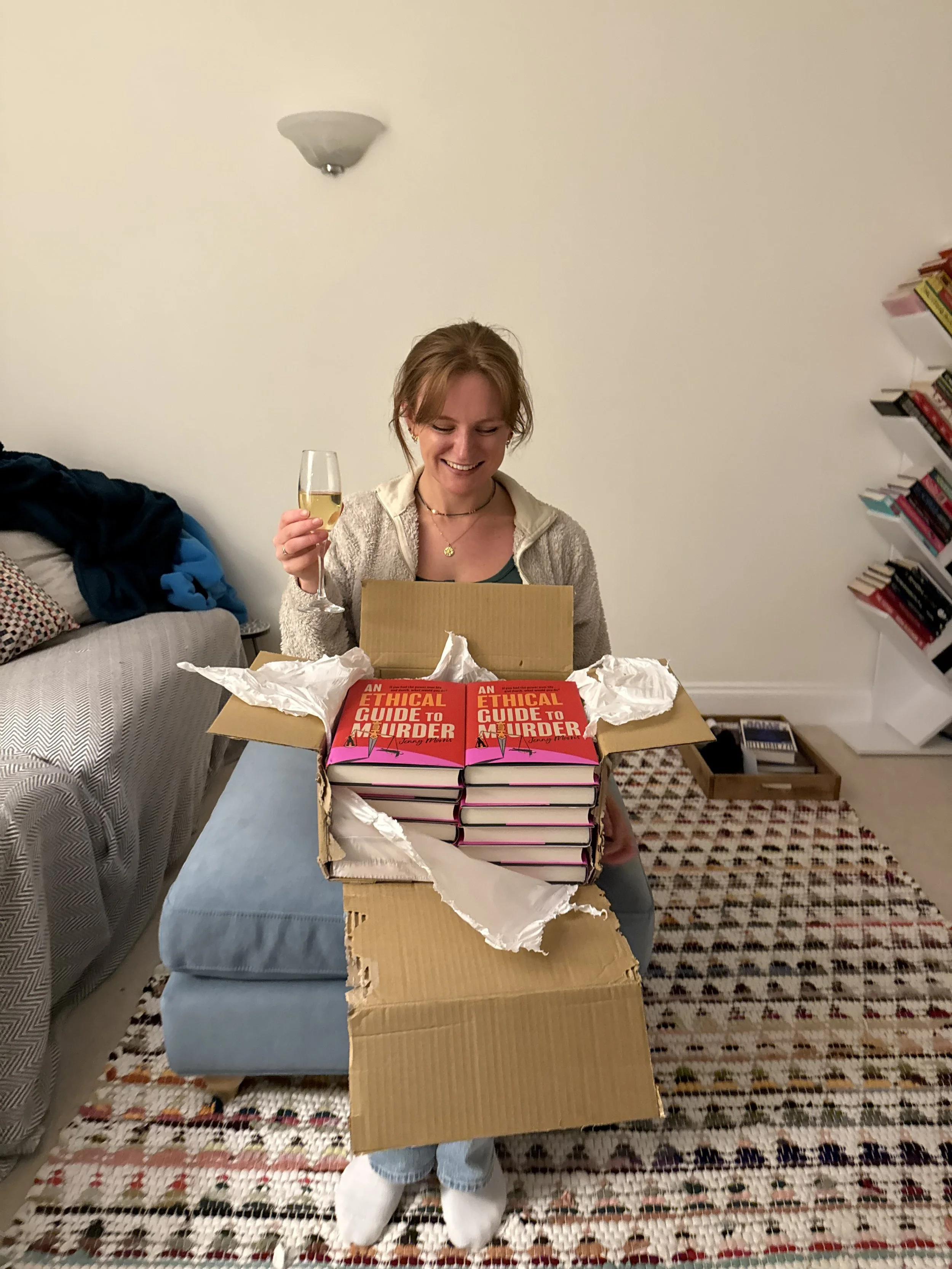
Staring at my book babies with what I can only describe as deep maternal feelings.
Growing up, I wanted to be a scientist rather than a writer. I loved the idea that all the answers to my questions could be found in a book. Then, halfway through my PhD in research psychology, one of my closest friends suddenly and unexpectedly died at just twenty-two years old. I started writing to help me process this grief. Then I realised writing was another way for me to explore the questions I had about the world — which, after losing someone I loved, had become much more complicated and harder to find answers for.
Once I’d caught the writing bug, I wanted to get better at it. Maybe because of my academic background, I took a methodical approach to this. I studied lots of craft books, I took several short story courses (one by Penguin and another by Curtis & Brown) and I joined some online critique sites.
Then, I had an idea for a speculative thriller that got me a place on the Faber Academy six-month Writing a Novel course in 2020. If you have an opportunity like this, go for it. The course was brilliant, but it was being around other like-minded writers and critiquing each other’s work that made it so valuable.
I sent the novel out to agents, had some interest and a few full requests, but ultimately got nowhere. In hindsight, I’m glad because it was absolutely a “practice novel.” But at the time, I was disheartened by how tough it was to get published, so I planned to give writing a break. I left academia and threw myself into a new job, turning self-development books into online courses – which turned out to be unexpectedly helpful for my writing, especially for creating better characters. Then, I had the idea for An Ethical Guide to Murder.
From the start, I knew there was something different about this one. It started as a short story — which won the speculative fiction contest in Writers Magazine (which you can read here if you’re interested, and promise not to judge my writing skills from many years ago). But the idea of a woman who can save people, but only by stealing life from others (killing them in the process), stuck with me. And when I described the idea to other people, they didn’t just feign interest, they grilled me on exactly how Thea’s power worked.
It took me a year to finish the novel. I sent it to 12 agents… and got nowhere… again. I don’t think 12 rejections necessarily indicates your work isn’t good enough, but I felt something was off. I sat on the book for another year. I would have happily continued to do so because it can be more appealing to potentially have the next bestseller on your computer than to have it confirmed that you don’t. My mum insisted I see it through and send it out. I think having someone in your corner who believes in your writing even when you don’t is the single most valuable thing you can have. Although she also suffered through living with me while I wrote it, and I’m not fun when I write, so I think she also wanted there to be a point to it.
I gathered some final feedback from friends and ended up making a huge edit, completely changing the ending, and sent it out to agents again.
This time, I got a few full manuscript requests and found my agent, Francesca Ricciardi, from Kate Nash literary agency in August 2023. Francesca’s email went to my junk folder, so I got a call out of the blue asking to read it. I’m still hoping that at the time, I seemed very cool fighting off my thousands of manuscript requests whereas in reality, one agent had read the full and passed, and another was reading the full. We chatted on the phone, and Francesca asked me why I'd pitched the novel as book-club/speculative fiction instead of crime (somehow having “murder” in the title didn’t tip me off). I had a misconception that crime books were all murder mysteries (which I love, but I don’t write), instead of a hugely diverse genre.
Francesca completely “got” my story, and I loved that she was excited about my future book ideas, so I accepted her offer of representation straight away. After that, everything happened incredibly quickly. We made a few minor edits, sent out the manuscript in September, and received an offer for a two-book deal from Simon & Schuster at the beginning of October.
I’ve loved the process since then. I had structural edits to do, but once you’ve tried to edit on your own, no idea if things are getting better or worse, it feels so brilliant to do it with the direction and support of someone who knows what they’re doing. I was also so grateful to everyone who worked on the book — from the edits to the beautiful cover – helping to create something I could never have done by myself. Every time I see it in bookshops I pinch myself, and love it when people send my pictures of Ethical Guide in the wild.
TLDR tips
· Know your genre — I wish I’d realised I was a crime writer much earlier.
· Embrace the journey. Sorry for the cliché but it’s true. Getting published takes time so try to enjoy writing for its own sake. Not neglecting the other parts of your life — friendships, family and work— can help you cope with the inevitable rejections much more easily.
· Avoid clichés ;)